Workplace risk assessment for workshops, mechatronics & trades
Machines, tools, electrical installations and hazardous substances: in workshops and commercial businesses, the risk assessment needs special attention – often down to a detailed machine assessment.
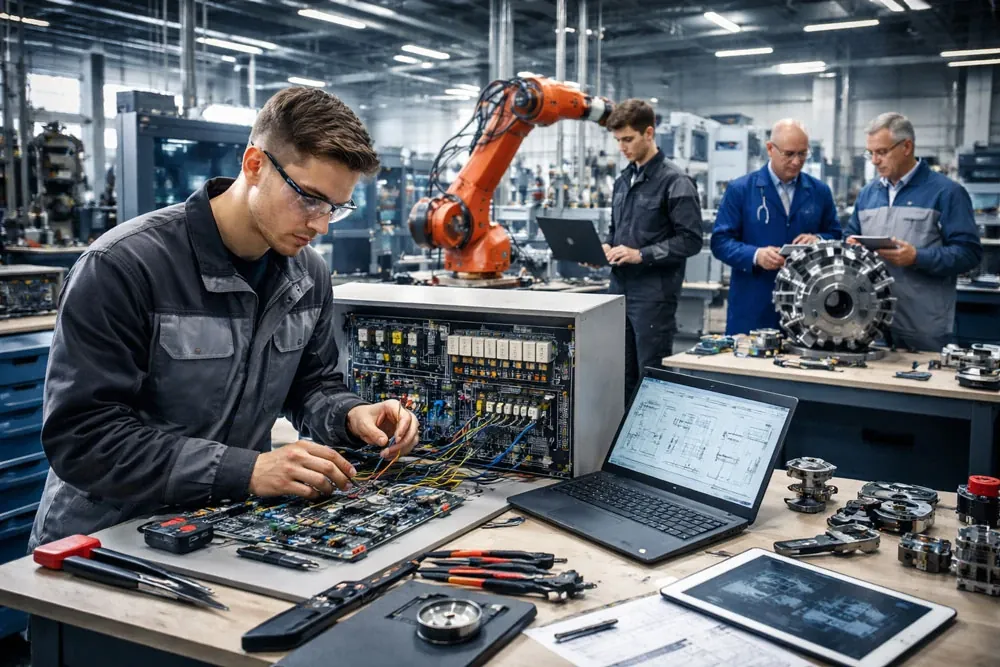
Typical hazards & deadlines
In mechatronics businesses, workshops and commercial settings, the workplace risk assessment requires particular attention to machines, tools and work processes.
Typical hazards
- mechanical risks at machines, drills, presses
- electrical hazards (exposed cables, test equipment)
- noise, eye and hand injuries
- flammable and hazardous substances (sprays, lubricants)
Relevant deadlines
- Repeat inspections of electrical work equipment – every 12 months or as specified by the responsible electrician
- Training in machine operation – annually
- Maintenance / inspection of extraction systems (e.g. for grinding work)
- Update the hazardous substances register & risk assessment annually
- PPE training (e.g. safety glasses, hearing protection)
What we do for you – industry-specific workplace risk assessment
Every industry has its own hazards and requirements. We support you with a practical, legally compliant risk assessment – tailored to your business. From the initial walk-through to the digital documentation.
Recognising hazards – clearly and practically
Many companies do not know which hazards are actually relevant. We bring the know-how and the right tools:
- Industry-specific hazard catalogues & checklists
- Identification of typical weak points – from machines to traffic routes
- Photo documentation & on-site recording directly at the installation
- Joint review with employees – understandable & solution-oriented
Planning measures – structured & feasible
Based on the risk assessment, we draw up a clear action plan for you:
- Specific measures with responsible persons & deadlines
- Prioritisation according to the risk assessment (e.g. traffic-light system)
- Practical to implement – even for smaller businesses without a dedicated department
- Optional: QR codes on machines, linked to documents & inspection reports
Legally sound documentation – digital or traditional
We make sure you meet all requirements of the ASchG & DOK-VO:
- Preparation of the risk assessment documents (PDF or structured digital)
- Industry-specific training documents & operating instructions
- Setting up simple deadline management (e.g. with a QR system or calendar plan)
- Support during inspections by the Labour Inspectorate or AUVA
Examples from practice
Food & bakeries
Crushing points on dough machines, heat risks, hygiene
Cleaning plans, HACCP assessment, hygiene training
Workshops, mechatronics, mechanical engineering, contract manufacturing in metal or wood, joinery
Machine safety, guards, electricity
Operating instructions & risk assessment directly at the installation
Logistics & warehousing
Traffic routes, racking safety, forklift operation
Inspection plans, training, deadline calendar
Care & social facilities
Physical strain (patient handling), infection risks, psychological stress (shift work, pressure), slips and trips
Our goal: your safety – simple and efficient
We bring structure, clarity and experience – so that your risk assessment does not become red tape but makes a real contribution to safety, traceability and legal certainty.
We are happy to offer you a free initial consultation.
Frequently asked questions from the industry
What is assessed in workshops?
In workshops and craft businesses, the focus is on:
- machine and tool hazards
- electrical installations
- lifting and carrying strain
- tidiness, cleanliness and maintenance
A detailed machine assessment is often required here.
When does the obligation to carry out a risk assessment apply?
The following applies in all industries:
- mandatory from the first employee
- part-time staff and apprentices are included
How does an industry-specific workplace risk assessment work?
- Identification of the hazards typical of the industry
- Assessment of the risks
- Definition of specific measures
- Documentation in accordance with the ASchG
- Employee safety training
Do employees have to be trained?
Yes. In every industry, employees must be:
- informed about hazards
- instructed in protective measures
- given regular refresher training
The training must be documented as evidence.
What are the advantages of an industry-specific risk assessment?
- practical measures instead of standard solutions
- greater acceptance among employees
- more legal certainty during inspections
- noticeable improvement in safety & health
Which solution suits your business?
Free and without obligation: together we clarify which requirements apply to your business and the fastest way to a complete risk assessment.