Checklist: what to do after a workplace accident (Austria)
Immediate action, reporting to AUVA and the Labour Inspectorate, documentation and re-evaluation – the steps employers in Austria need to take.
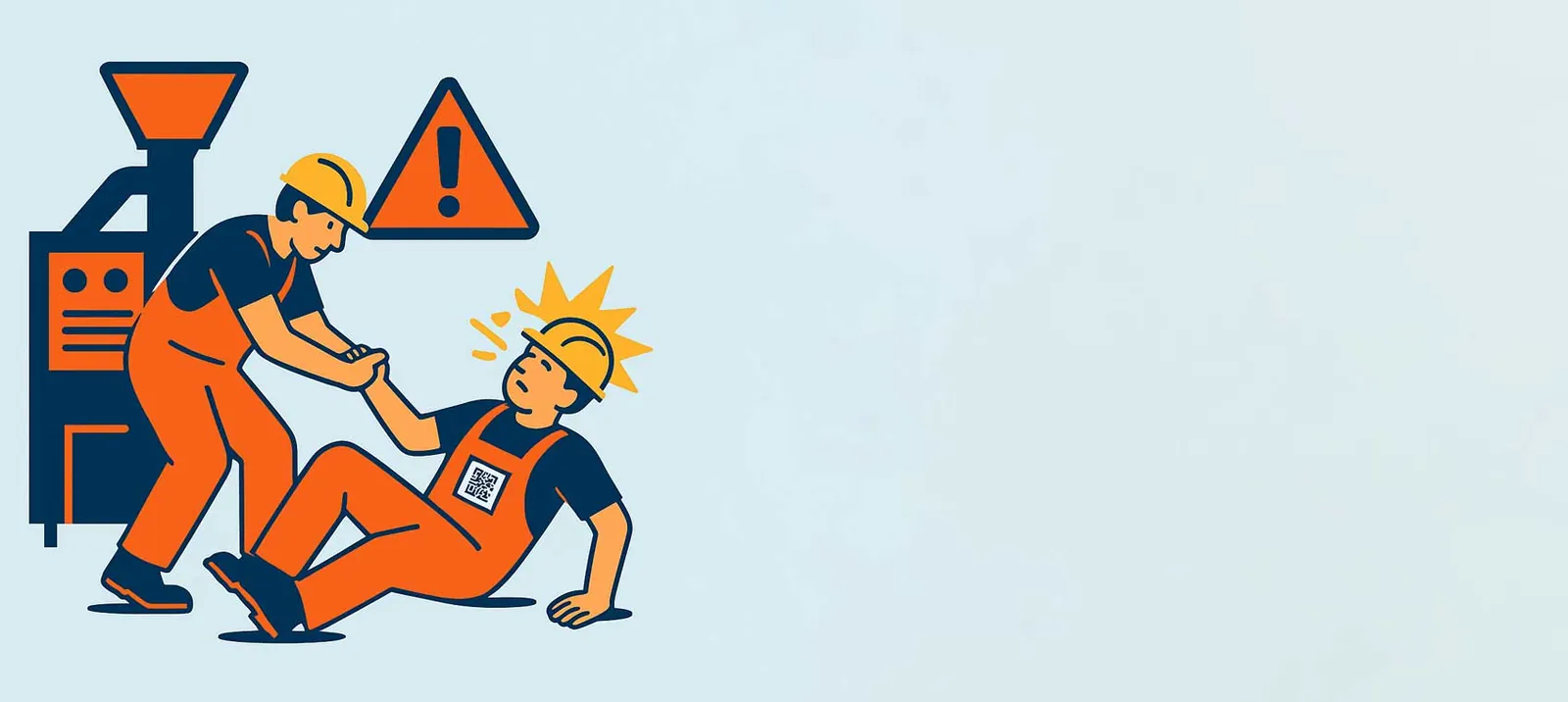
After a workplace accident, Austrian law (ASchG, DOK-VO, ASVG) and good practice require several steps. This checklist gives you a structured overview with explanations and the relevant legal bases, so that you take the right measures and prevent future accidents.
1. Immediate action at the scene
- Give first aid: make sure the injured person receives first aid immediately. If necessary, call in a first aider and make an emergency call (ambulance 144, fire brigade 122, etc.). Fast first aid is crucial to minimise damage to health.
- Secure the scene: secure the accident area to prevent further danger to others. Switch off machines or installations if necessary and cordon off the area. Make sure no follow-up accidents can happen (e.g. with warning signs or barriers).
- Reassure and look after those affected: stay calm and look after the injured until professional help arrives. If necessary, move the person out of the danger zone (only if this can be done safely) and position them correctly (recovery position if unconscious, etc.).
Note: every business must ensure that first aid can be given without delay (sufficiently trained first aiders and first-aid supplies are mandatory). Prompt first aid can save lives.
2. Recording and documenting the accident
- Report the accident internally: inform the direct supervisor immediately. Employees are legally obliged to report every workplace accident – and also near misses – to the employer or the responsible person without delay. This internal report ensures that the business responds immediately.
- Document the details: record how the accident happened in writing. Note the date, time, location, persons involved and witnesses, a description of how the accident came about and the injuries sustained. If possible, collect evidence: take photos of the scene, secure the equipment or parts involved and note witness statements. Careful documentation is important for later analyses and reports.
- Keep a first-aid book / accident record: enter injuries, even minor ones, in the first-aid book or an accident record. It documents first-aid measures and injuries and also serves as evidence if medical consequences appear later.
- Archive the records: employers must keep accident records – for at least five years for every fatal accident and for accidents resulting in more than three calendar days of absence. Keep a register of all reportable workplace accidents and store the reports for at least five years. On request, these reports must be presented to the Labour Inspectorate.
Tip: use your own accident report forms or checklists so that nothing is overlooked. Complete documentation makes later analysis and reporting to the authorities easier.
3. Reporting to AUVA and the authorities
- Notify the accident insurer (AUVA): the employer must report every workplace accident in which an insured person is killed or is completely or partially unable to work for more than 3 days to the responsible accident insurance institution (usually AUVA) within 5 days. This accident report is made on the official form – an online form that can be submitted electronically is now available. Fill in the report completely (ideally together with the injured person or witnesses) and submit it on time. Note: AUVA automatically forwards a copy of the report to the Labour Inspectorate.
- Inform the Labour Inspectorate: fatal or serious workplace accidents must be reported to the responsible Labour Inspectorate without delay (unless the police have already been notified). A "serious workplace accident" is, for example, one with life-threatening or serious permanent injuries (in practice, accidents with more than 24 days of sick leave or comparable severity are often classed as serious). If the police are already on site and informed, they notify the Labour Inspectorate themselves. To be on the safe side, however, the employer should make the report actively (by phone and in writing). The legal basis is § 98 ASchG and § 20 (3) ArbIG (Labour Inspection Act).
- Observe special cases: other reporting duties may apply in addition to the ASchG and ASVG. For example, § 15 of the Electrotechnics Act requires personal injury caused by electric current or lightning to be reported to the authority. For special causes of accidents, check whether additional reports are required.
- Official investigation: serious accidents may lead to official investigations (police, Labour Inspectorate). Cooperate with the authorities, provide documents and leave the scene unchanged as far as possible until the investigation is complete.
4. Internal communication and cooperation
- Inform supervisors and management: make sure the responsible managers (heads of department, management) are informed promptly. There should be a clear internal reporting chain so that all relevant functions (occupational safety, HR etc.) are aware.
- Involve the safety representative: inform the elected safety representative (Sicherheitsvertrauensperson) of the accident. The safety representative represents employees in occupational safety matters and has the right to access the accident records. They can help to identify causes and develop preventive measures.
- Inform the safety specialist and occupational physician: involve the company's prevention specialists – in particular the safety specialist and the occupational physician. They should receive all accident reports and records in order to fulfil their duties. They support the accident analysis, the assessment of health risks and the definition of improvements. Investigating and evaluating the causes of accidents is part of prevention work and can be counted towards their prevention time.
- Inform the workforce (where appropriate): depending on the severity of the accident and how the team is affected, it may make sense to inform colleagues about the incident and any measures taken – e.g. in a team meeting. This creates transparency and raises awareness of safe behaviour. However, respect data protection and the privacy of the injured person.
5. Accident analysis and risk assessment (re-evaluation)
- Identify the causes: carry out a systematic accident analysis. Reconstruct the course of events and identify the cause(s): which hazard materialised? Was human error, technical failure or an organisational shortcoming decisive? Use methods such as root cause analysis (e.g. 5-Why method, Ishikawa diagram) to find the underlying causes. Document the results, e.g. in an accident report or analysis form.
- Review the risk assessment: review the existing risk assessment (workplace evaluation) for the area concerned. According to § 4 (5) no. 1 ASchG, hazards must be re-identified and re-assessed after workplace accidents and the evaluation must be adapted where necessary. This means going through the risk analysis again to determine whether all hazards had been recognised and whether the assessment is still correct. If the accident reveals new hazards or requires a different assessment, this must be reflected in the evaluation.
- Carry out a re-evaluation: carry out a targeted re-evaluation of the cause of the accident. Examine why the existing protective measures were insufficient or failed. If necessary, call in external experts (§ 4 (6) ASchG allows suitable experts such as occupational psychologists or toxicologists to be involved in the hazard assessment). The aim of the re-evaluation is to derive specific improvements so that such an accident does not happen again.
- Record the findings: record the results of the hazard assessment in writing – usually in the safety and health protection document (the documentation of the workplace risk assessment). Under the DOK-VO, it must document, among other things, all identified hazards and the measures defined to prevent them. New or changed hazards and measures from the re-evaluation must be added accordingly.
6. Creating or updating the hazard catalogue and action plan
- Update the hazard catalogue: review the hazard catalogue (the list of all hazards identified in the business). If the accident analysis revealed hazards that had not yet been recorded, they must be added. If the hazard was already known, check whether its classification (e.g. risk rating) needs to be adjusted. Every new hazard factor identified must be added to the document.
- Revise the action plan: derive specific measures from the re-evaluation to avoid or minimise the identified hazards in future, and adapt the action plan accordingly. Under § 4 ASchG, employers must define suitable measures to prevent hazards on the basis of the hazard assessment. For each measure, document what needs to be implemented and – if it cannot be implemented immediately – who is responsible and by when it must be done. Examples: technical changes to machines, additional guards, changed work processes, more training or personal protective equipment (PPE).
- Prioritise measures: assess the urgency of the measures. Short-term measures should be implemented immediately (e.g. locking out a defective device, temporary guards). Long-term measures (e.g. structural changes, purchasing new safety technology) should be scheduled and tracked. Make sure deadlines and responsible persons are defined for all open measures.
- Involve those affected: ideally develop the action plan together with the employees concerned, the safety representative and the prevention specialists. Their practical know-how ensures the measures are feasible and effective – and acceptance increases when employees are involved in finding solutions.
7. Checking the effectiveness of existing protective measures
- Check effectiveness: analyse critically why the existing protective measures did not prevent the accident. By law, the defined measures must be checked regularly for effectiveness. Check: were the existing measures followed correctly (e.g. were the operating instructions known and observed)? Were the guards and PPE intact and used? Were there organisational gaps (e.g. unclear responsibilities or missing checks)?
- Identify weak points: establish whether a measure failed (e.g. human error, inattention, incorrect operation) or whether it was unsuitable or insufficient. An accident often indicates that a hazard was not assessed correctly or a protective measure was not sufficient. Identify these weak points in the existing safety concept.
- Adapt existing measures: determine which existing measures need to be improved or supplemented. Technical equipment may need to be retrofitted, maintenance intervals shortened, additional guards installed or organisational procedures changed. More training or practice may also be needed if human error played a role. The ASchG explicitly requires working conditions to be improved continuously – so use the findings to raise the overall level of protection.
- Document effectiveness: record the results of this review: which measures worked well and will be kept, and which were found to be insufficient. This documentation becomes part of the risk assessment documents and serves as evidence during later inspections (e.g. by the Labour Inspectorate) that the accident was dealt with thoroughly.
8. Updating the risk assessment documents
- Update the safety and health protection document: update the written risk assessment documentation in line with the DOK-VO. If the hazard assessment has been reviewed and measures adapted (§ 4 (4) and (5) ASchG), the safety and health protection document must also be adapted accordingly. Add all new findings: newly identified hazards, changed risk ratings and newly defined measures. The document must show who carried out the review, when and for which area.
- Versioning and accessibility: give the updated document a new date and version. Make sure everyone entitled has access to the current version (e.g. digitally on the intranet or as a folder on site). If electronic systems are used (e.g. QR codes on machines leading to the digital risk assessment), update these links too, so that scanning shows the latest safety information. The DOK-VO also permits digital or graphical documentation – what matters is that all employees have easy access to the relevant information.
- Hazard signs and operating instructions: check whether warning signs or operating instructions on site need to be adapted. If, for example, a new warning sign is needed or operating instructions must be improved (perhaps with a QR code linking to digital instructions), implement this. Update training documents and emergency plans as well if necessary.
- Communicate the changes: inform the workforce and, if necessary, the Labour Inspectorate about significant changes to the risk assessment. During an inspection, it is expected that the evaluation has been updated after an accident. Proactive communication shows that you have met your duty as an employer.
9. Training employees (refresher training)
- Safety training after the accident: consider whether it is necessary and helpful to train employees again after the accident (especially in the area concerned). The ASchG requires that employees be trained after accidents or near misses if this appears useful to prevent further accidents. In practice: hold a targeted safety briefing in which you describe the accident anonymously, explain the causes and sources of error and present the new or changed protective measures.
- Use the learning effect: discuss what can be learned from the accident. Emphasise compliance with safety rules and address correct behaviour. If the accident was caused by incorrect handling, for example, demonstrate the correct procedure again. The training can take place in a small group (the department concerned) or company-wide – depending on where action is needed.
- Document the training: record the date, content and participants of the training in writing (training record), as this should also be verifiable by the authorities. Have employees confirm their participation by signature if appropriate.
- Psychological aftercare: also consider the psychological side: a serious accident can unsettle or traumatise employees. If necessary, organise psychological support for those directly or indirectly affected (e.g. through workplace health management or AUVA). This is also part of responsible follow-up after a workplace accident.
10. Conclusion: strengthening prevention for the future
These steps ensure that after a workplace accident, not only do the injured receive the best possible help, but lessons are also learned from the event. Uncovering the causes, improving measures and keeping the documentation up to date are key duties for employers to continuously increase safety in the business. A thorough re-evaluation under § 4 ASchG and consistent implementation of the resulting measures reduce the risk of further workplace accidents. What matters is that occupational safety is taken seriously and communicated transparently – creating a living safety culture that protects all employees.
Legal sources and references: this checklist is based on the requirements of the Austrian Employee Protection Act (ASchG), the Safety and Health Documentation Ordinance (DOK-VO), the accident insurance provisions of the General Social Insurance Act (ASVG) and recommendations of AUVA and the Labour Inspectorate. Key provisions include § 4 ASchG (workplace risk assessment and re-evaluation after accidents), § 98 ASchG (reporting fatal/serious accidents), § 15 (5) ASchG (employees' duty to report), § 16 ASchG (record-keeping), § 14 ASchG (training duties) and § 363 ASVG (reporting to the accident insurer). Fulfilling these obligations – supplemented by sensible company measures – ensures that all necessary steps are taken after an accident to limit damage to health and prevent future accidents.
This information is provided for guidance and does not replace legal advice.
Which solution suits your business?
Free and without obligation: together we clarify which requirements apply to your business and the fastest way to a complete risk assessment.